Contents
How to Read a Coffee Flavor Wheel
TL;DR: The coffee flavor wheel explained in one sentence: it’s a tiered visual map that moves from broad categories (fruity, floral, nutty) in the center to precise descriptors (jasmine, black currant, hazelnut) at the outer ring. Start at the center, work outward, and match what you taste to a specific outer-ring term. It makes your tasting notes precise and repeatable.
What Is a Coffee Flavor Wheel?
The coffee flavor wheel is a standardized reference chart developed by the Specialty Coffee Association (SCA) and World Coffee Research. It organizes over 110 sensory descriptors into a circular map with three tiers: broad categories → subcategories → specific descriptors. Use it to translate vague impressions (“tastes like fruit”) into precise, communicable language (“tastes like dried apricot with a hint of tamarind”).
 Photo: cottonbro studio via Pexels
The current wheel was updated in 2016 in collaboration with World Coffee Research, replacing the original 1995 SCAA version. It’s grounded in sensory science: each descriptor corresponds to a reference standard defined in the World Coffee Research Sensory Lexicon, meaning “blackcurrant” isn’t a guess — it has a measured intensity and a physical reference sample.
The wheel isn’t just for competition judges or Q graders. It’s a practical tool for anyone who wants to stop saying “it tastes like coffee” and start tasting what’s actually in the cup.
How to Read the Flavor Wheel: Tier by Tier
Read the wheel from the inside out. The inner ring holds nine broad categories. The middle ring splits each into subcategories. The outer ring names the specific flavor. Your job is to land on one or two outer-ring descriptors that match your cup — not to catalog every note possible.
 Photo: Jonathan Borba via Pexels
The Inner Ring: Broad Categories
There are nine top-level categories on the SCA wheel:
| Category | What It Covers |
|---|---|
| Fruity | Dried fruit, berry, citrus, stone fruit, tropical |
| Floral | Chamomile, rose, jasmine |
| Sweet | Vanilla, caramel, overall sweetness impression |
| Nutty/Cocoa | Hazelnut, almond, dark chocolate, cocoa |
| Spices | Brown spice, pepper |
| Roasted | Tobacco, ash, cereal, burnt notes |
| Green/Vegetative | Under-ripe, olive, raw |
| Other | Chemical, papery, rubber — mostly defect territory |
| Sour/Fermented | Alcohol-like, overripe, fermented |
If you can name which category a flavor belongs to, you’ve already done the hard work. Everything after this is just narrowing down.
The Middle Ring: Subcategories
Once you’ve landed on “Fruity,” the middle ring asks: is it dried fruit, citrus, berry, or stone fruit? This is where tasting becomes more deliberate. Sip again with that subcategory in mind. You’re not searching randomly — you’re ruling things out.
 Photo: Michael Burrows via Pexels
The Outer Ring: Specific Descriptors
The outer ring gives you the final vocabulary: lemon, grapefruit, lime under Citrus; peach, nectarine, cherry under Stone Fruit. These are the terms that make tasting notes useful. “Notes of dried cherry and cocoa” tells someone what to expect in a way that “fruity and dark” doesn’t.
One note: these descriptors are associations, not ingredient lists. Coffee doesn’t contain blackcurrant. Your brain is pattern-matching flavor compounds to stored sensory memories. A high-grown washed Ethiopian Yirgacheffe produces a compound (methyl anthranilate, among others) that your brain maps to “blueberry.” The wheel gives that recognition a shareable name.
How to Actually Use It While Tasting
Taste first, wheel second. If you glance at the wheel before your first sip, you’ll anchor on whatever you see and confirm it rather than discover it. Blind first impression → then consult the wheel to refine.
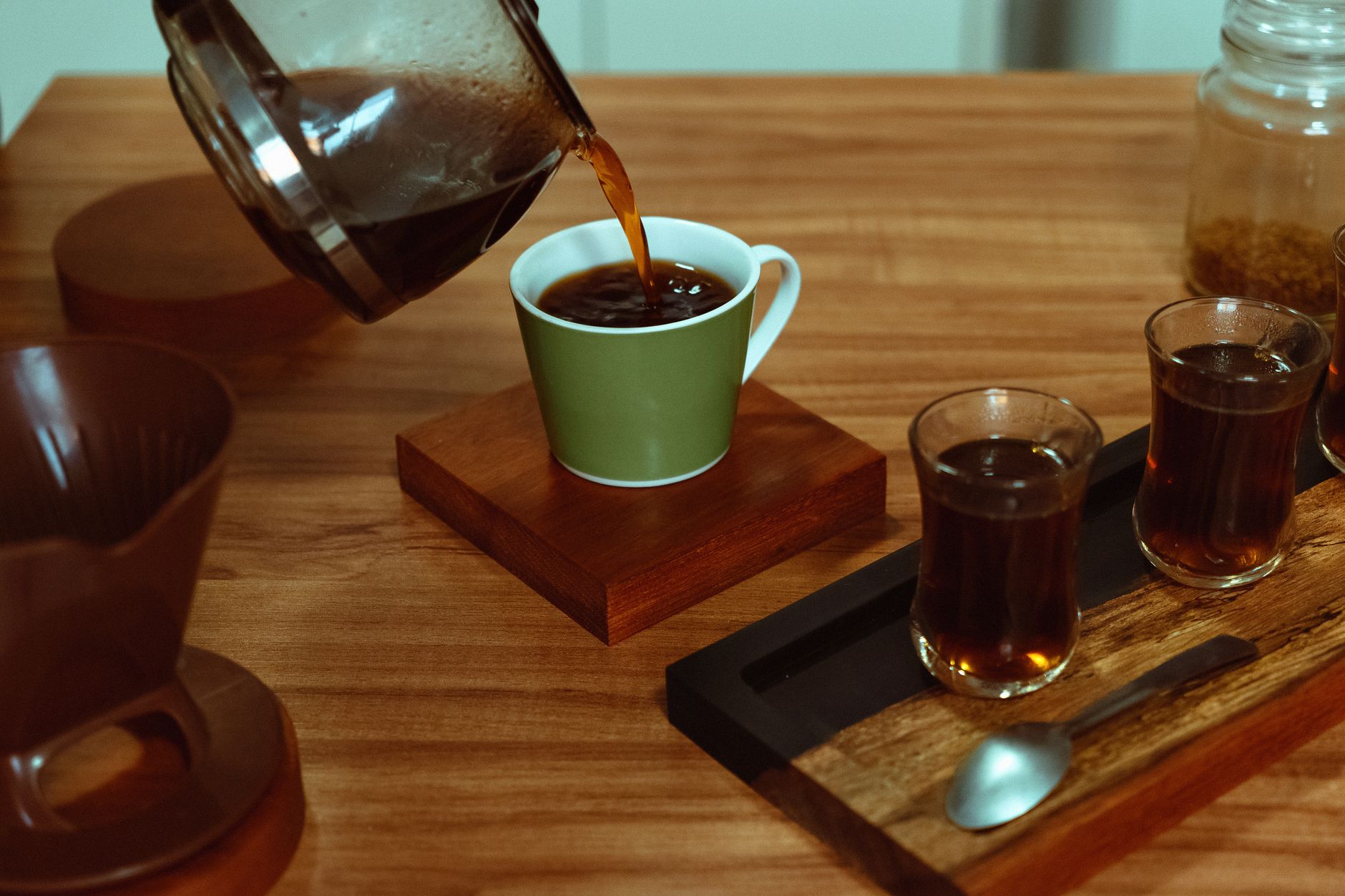 Photo: Lucas Andrade via Pexels
Here’s a practical four-step process:
- Smell dry grounds — aroma before any water hits the coffee. Note your first instinct, even if vague.
- Sip and hold — let the coffee sit on your tongue for 3–5 seconds before swallowing. This engages retronasal olfaction, where most flavor perception actually happens.
- Name the category — pick one inner-ring category that matches your strongest impression. Don’t force two.
- Work outward — move to the subcategory, then the outer ring. If two descriptors feel equally right, that’s fine; most coffees have layered flavor.
Repeat on the second and third sip. Flavor perception shifts as the coffee cools — many coffees reveal their best notes at 60–65°C (140–150°F), not scalding hot.
A Worked Example
You’re tasting a washed Kenyan AA. First impression: bright, almost sharp. That points toward Sour or Fruity in the inner ring, not Roasted or Nutty. Move to the middle ring under Fruity → Citrus or Berry? The sharpness reads more citrus. Outer ring: lemon or grapefruit? There’s a juicy, round quality — grapefruit. As it cools, a secondary note emerges, darker and jammy. Back to the inner ring → Fruity → Berry → blackcurrant.
Final tasting note: “Grapefruit and blackcurrant, clean finish.” That’s a communicable, precise description built in under 90 seconds.
Common Mistakes When Using the Flavor Wheel
The most common mistake is treating the outer ring as a checklist. You’re not trying to find every descriptor on the wheel — you’re trying to find the two or three that are true. A three-note profile written honestly is more useful than eight notes written to sound interesting.
| Mistake | Why It Matters | Fix |
|---|---|---|
| Reading the wheel first | Anchors you to what you see | Taste blind, then consult |
| Listing too many descriptors | Dilutes accuracy, sounds like noise | Commit to 2–3 honest notes |
| Ignoring the defect side | “Green/Vegetative” and “Other” categories describe real problems | If something tastes off, name it |
| Tasting at boiling temp | Burns taste receptors, suppresses complexity | Wait for 140–150°F |
| Using the wheel as decoration | Flavor language only develops with practice | Use it every brew, not just special occasions |
→ See Also
- Coffee Science: The Complete Guide to Extraction, Chemistry & Flavor
- How Much Caffeine Is in a Cup of Coffee? (All Brew Methods)
- Caffeine in Espresso vs Coffee: Which Has More?
FAQ
What is the coffee flavor wheel and who made it? The coffee flavor wheel is a sensory reference tool created by the Specialty Coffee Association (SCA) in collaboration with World Coffee Research. The current version, released in 2016, organizes 110+ flavor descriptors into three tiers — from broad categories to specific tastes. It’s grounded in the World Coffee Research Sensory Lexicon, a peer-reviewed flavor science database.
Do I need special training to use the coffee flavor wheel? No. The wheel is designed for anyone willing to taste deliberately. Professional Q graders use it in certification exams, but home brewers benefit from it just as much. The main skill it builds — naming what you taste rather than vaguely enjoying it — develops with repetition, not credentials.
Why do different coffees land in such different parts of the wheel? Processing method, origin, altitude, and roast level all push flavor chemistry in different directions. A natural-processed Ethiopian will cluster in the Fruity and Floral zones. A dark-roasted Brazilian tends toward the Roasted and Nutty side. Terroir and post-harvest choices create genuinely different volatile compounds, not just marketing language.
Can I use the flavor wheel for espresso as well as filter coffee? Yes, though espresso’s concentration can compress subtle notes. The same wheel applies — the categories don’t change. Espresso often amplifies Roasted, Nutty, and Caramel notes, while a light-roast pour-over might showcase Floral and Fruity more clearly. If anything, espresso is harder to parse precisely because intensity can mask individual descriptors.
What’s the difference between aroma and flavor on the wheel? The wheel covers both, but doesn’t separate them explicitly — that’s intentional. Most of what you perceive as “flavor” is actually retronasal aroma (smell from inside the mouth as you swallow). Orthonasal aroma (sniffing before tasting) often previews the same notes. If your nose says “berries” and your mouth says “citrus,” the retro-nasal impression from the sip is usually more reliable for tasting notes.
What do the defect categories on the wheel mean? The “Green/Vegetative,” “Papery/Musty,” “Chemical,” and “Sour/Fermented” zones at the bottom of the wheel describe processing or storage defects. Grassy notes often mean under-developed roast. Fermented or alcohol-like notes can indicate over-fermented processing. Papery or cardboard notes usually mean stale coffee or oxidation. These aren’t pleasant, but naming them helps you trace the problem.
Editorial methodology: Assessments are based on manufacturer specifications, published user reviews, and editorial research. Physical hands-on testing is noted explicitly where it occurred. Rankings reflect our editorial judgment and are not influenced by affiliate commission rates. Full editorial policy · Affiliate disclosure