Contents
Stepless vs Stepped Grinder Adjustment: Which Wins?
TL;DR: Stepless grinders let you dial in any grind size continuously, making them better for espresso precision. Stepped grinders click between fixed increments, which is faster and repeatable but limits fine-tuning. For espresso, stepless wins. For drip and filter brewing, stepped is usually good enough.
What’s the Actual Difference?
Direct Answer: A stepless grinder moves its burrs through a continuous range with no fixed positions — you stop wherever you need. A stepped grinder has discrete click positions, typically 10–40 microns apart. Stepless = more precision, higher learning curve. Stepped = faster workflow, less flexibility.
 Photo: Omar Tapia via Pexels
The mechanism is straightforward. Stepped grinders use a ratchet or detent system that locks the upper burr into set positions. You feel the click, you know exactly where you are. Stepless grinders use a friction collar or thread mechanism — you rotate freely and stop where extraction tells you to.
The gap between steps on a budget stepped grinder can span 20–50 microns. That’s a meaningful jump at the espresso range, where the sweet spot might sit between two clicks.
Stepless Grinders: Precision at a Cost
Direct Answer: Stepless adjustment gives you infinite resolution across the grind range. For espresso on a single-boiler machine where temperature and pressure vary day to day, this lets you compensate with grind instead of guessing between fixed positions.
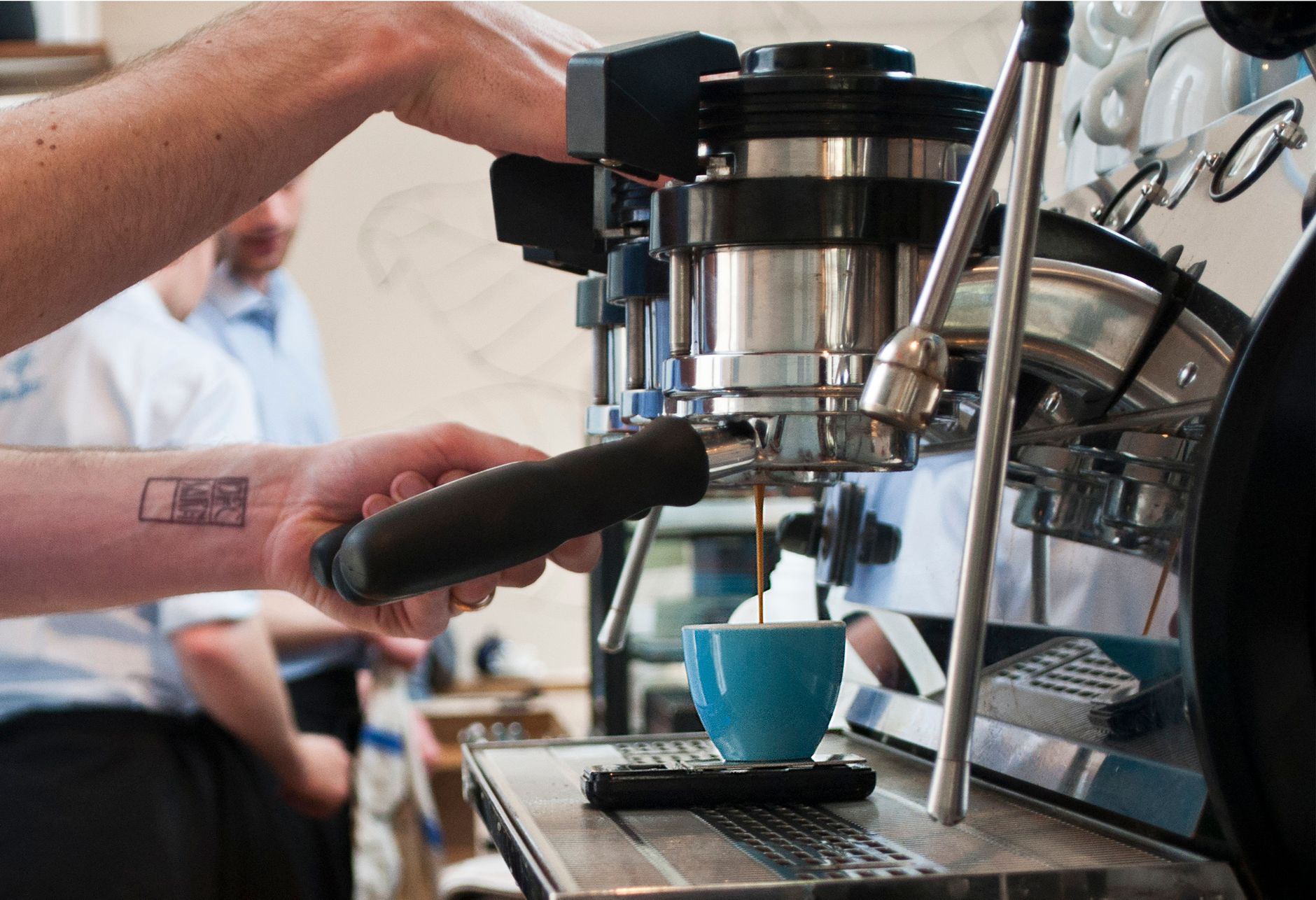 Photo: Amelia Hallsworth via Pexels
When Stepless Adjustment Is Worth It
If you’re pulling espresso with a puck that behaves differently on a humid Tuesday versus a dry winter morning, stepless is your tool. Microdosing the adjustment — half a degree on the collar — can swing a 35-second shot to 28 seconds without changing dose or yield.
The 1Zpresso JX-Pro
The tradeoff is drift. Without a locking mechanism, friction collars can shift under vibration or careless handling. Good stepless grinders address this with tighter tolerances or locking screws; budget ones don’t.
Stepped Grinders: Speed and Repeatability
Direct Answer: Stepped grinders are faster to return to a known setting. If you switch between two coffees or brew methods regularly, clicking back to “position 12” is faster than remembering a collar angle. For non-espresso brewing, step resolution is usually fine.
 Photo: Tibor Szabo via Pexels
Where Stepped Adjustment Wins
Batch brewing, pour-over for multiple roasts, any workflow where you’re switching grind size often — stepped is genuinely better here. You write down “Ethiopian: 15 clicks, Colombian: 17 clicks” and you’re done. No eyeballing a collar mark.
Baratza’s entire consumer lineup uses stepped adjustment. The Encore
The issue surfaces when you’re chasing espresso extraction. If your ideal grind sits between click 8 and click 9 and you can’t get there, you’re stuck optimizing dose and ratio to compensate — a workaround, not a solution.
Head-to-Head Comparison
| Feature | Stepless | Stepped |
|---|---|---|
| Precision | Infinite resolution | Fixed increments (10–50µm) |
| Repeatability | Depends on build quality | Excellent — click memory |
| Espresso suitability | Excellent | Good (fine steps) to Poor (coarse steps) |
| Filter brewing | Excellent | Excellent |
| Learning curve | Higher | Lower |
| Price range | $50–$500+ | $30–$400+ |
| Best for | Espresso dialing, single-origin work | Multi-method, batch, beginners |
Stepless vs Stepped for Espresso Specifically
Direct Answer: Espresso requires grind adjustments as small as 5–10 microns to move extraction time meaningfully. Most stepped grinders at under $200 have steps of 20–50 microns — too coarse for precision dialing. If espresso is your primary use, stepless is the right call.
 Photo: Mahmut yılmaz via Pexels
Grind size is the primary lever in espresso. Water temperature, pressure, and dose are largely fixed once your machine is set. A 30-micron step on a low-end grinder forces you to compensate elsewhere or accept inconsistency.
Exceptions exist. The Niche Zero
Which Should You Buy?
| Your Situation | Recommendation |
|---|---|
| Espresso only, budget under $200 | Stepless (1Zpresso JX-Pro, Kingrinder K6) |
| Filter and pour-over only | Stepped (Baratza Encore, Comandante C40) |
| Both espresso and filter | Stepless with wide range, or two grinders |
| Beginners, any brew method | Stepped — simpler workflow |
| Café or high-volume home use | Stepless commercial (Eureka Mignon series) |
→ See also:
- The Complete Coffee Grinder Guide (2026)
- Burr vs Blade Grinder: Why It Matters for Your Coffee
- Best Coffee Grinders Under $100 (2026)
FAQ
Does stepless mean better grind quality? No. Stepless refers only to adjustment mechanism, not burr quality. A cheap stepless grinder with low-quality burrs will produce worse coffee than a quality stepped grinder. Burr geometry, alignment, and RPM matter more for grind quality than the adjustment system.
Can I convert a stepped grinder to stepless? On some grinders, yes — the Comandante C40 has a “Red Clix” mod that reduces steps from ~30µm to ~15µm. Full stepless conversion is rarely practical on consumer grinders. Buy the right tool rather than modifying the wrong one.
Why do professional café grinders use stepless? Café environments deal with changing humidity, bean density across roasters, and daily dial-in. Stepless adjustment lets a barista move in small increments during service without overshooting. Speed and precision matter at volume in ways they don’t at home with a single bag.
How many steps is “good enough” for espresso? Under 15 microns per step is generally fine for home espresso. Most grinders in this range are either truly stepless or use fine micro-stepped systems. Grinders with 30+ micron steps will require dose compensation at the espresso range.
Do stepless grinders lose their setting? Cheaper stepless grinders with friction-only collars can drift. Higher-quality stepless designs use metal threads, locking screws, or indexed rings that hold position reliably. Check reviews specifically for drift before buying — it’s a build quality issue, not an inherent flaw of stepless design.
Editorial methodology: Assessments are based on manufacturer specifications, published user reviews, and editorial research. Physical hands-on testing is noted explicitly where it occurred. Rankings reflect our editorial judgment and are not influenced by affiliate commission rates. Full editorial policy · Affiliate disclosure