Contents
Espresso Basket Types: Single, Double, and Triple
TL;DR: The double basket is the espresso industry standard — it holds 14–21g of coffee and suits nearly every setup. Single baskets (7–10g) are niche tools, often inconsistent. Triple baskets (21–24g) are for high-volume or large-format drinks. Choosing the right espresso basket type directly affects extraction quality and shot consistency.
What Are Espresso Basket Types?
The basket is the filter that holds your puck. Its volume determines dose, and dose determines everything downstream — grind, yield, time, and flavor. Getting the basket wrong before you dial in anything else is building on sand.
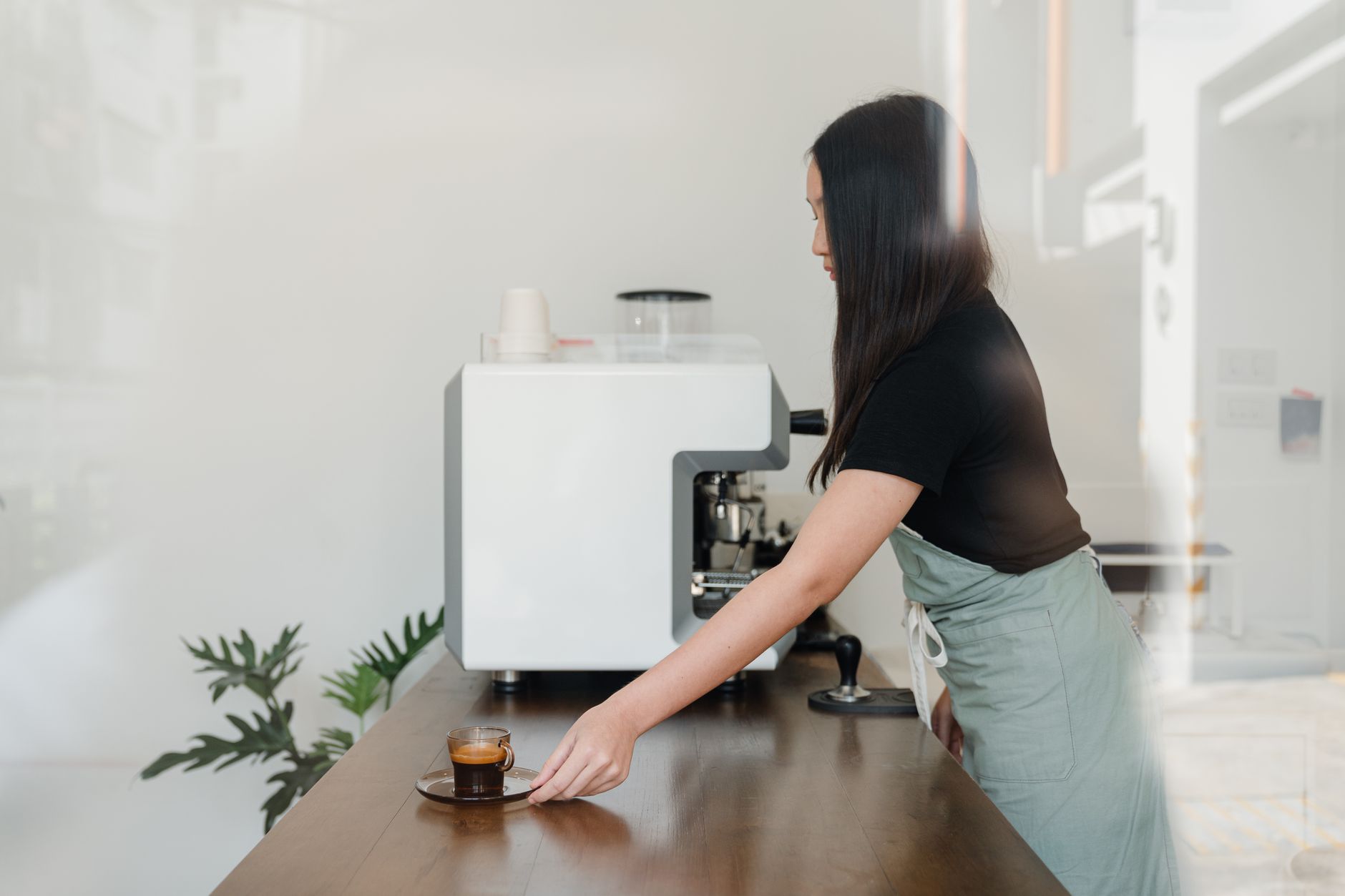 Photo: Ketut Subiyanto via Pexels
Espresso baskets sit inside the portafilter and hold the ground coffee during extraction. They’re perforated metal cylinders — usually stainless steel — precision-stamped or laser-drilled with hundreds of tiny holes. The basket geometry, hole pattern, and internal volume define how much coffee fits and how evenly water distributes through the puck.
Three variables matter most:
- Internal volume — how many grams of coffee it’s designed to hold
- Hole pattern — affects flow resistance and evenness
- Basket depth and diameter — determines puck thickness and headspace
Single Basket (7–10g)
Single baskets are rarely worth the trouble for home espresso. Their shallow depth creates thin, uneven pucks that channel easily. The narrow diameter makes distribution harder. For a single drink, just pull a double and serve half — or use a 1:2 ratio in a small double basket.
 Photo: Denys Gromov via Pexels
Single baskets are standard on many entry-level machines, particularly those sold with pressurized (dual-wall) portafilters. A pressurized basket has a secondary restriction built into the basket floor — it compensates for coarse grinds or pre-ground coffee by creating artificial back-pressure.
For anyone grinding fresh, single unpressurized baskets are a frustration. The shallow puck (often under 10mm) leaves almost no margin for distribution error. A slight tilt while tamping creates a channeling path that a 25-second shot can’t recover from.
When a single basket makes sense:
- Pressurized setups with pre-ground coffee
- Machines with a single-boiler design rated for 7–9 bar at low flow (some lever machines)
- Reducing waste when one espresso is genuinely the end goal
Double Basket (14–21g)
This is the default. Every grinder is calibrated around it, every recipe assumes it, and every barista skill is built on it. A quality double basket gives you the puck depth and surface area that makes consistent extraction achievable.
 Photo: cottonbro studio via Pexels
The double basket typically runs 14–21g depending on manufacturer. The most common target doses are 17–19g. The basket’s geometry — roughly 58mm diameter for E61 group heads — creates a puck depth of 15–20mm after tamping, which is the sweet spot for even water distribution.
Notable double baskets worth using:
| Brand | Capacity | Hole Type | Notes |
|---|---|---|---|
| VST 18g | 18g ±0.5g | Laser-drilled | Industry benchmark for precision |
| IMS Competition | 16–20g | Electroformed | Slightly forgiving, good flow |
| Decent Ridgeless | 14–20g | Laser-drilled | Ridgeless; requires naked PF |
| Stock Breville | 18–22g | Stamped | Adequate; VST is a clear upgrade |
The VST basket is the most commonly recommended aftermarket upgrade. The tighter hole tolerances mean more uniform flow resistance — which means your distribution and tamping technique has a direct, unfiltered effect on the shot. That’s a feature, not a flaw.
Triple Basket (21–24g)
Triple baskets are for commercial bars pulling large-format drinks or batch espresso. At home, they’re useful if you’re consistently dosing 20g+ — but most home machines don’t provide enough flow rate to extract a 23g puck evenly at 9 bar.
 Photo: Alexandre Canteiro via Pexels
A triple basket typically holds 21–24g. The larger volume requires a deeper group head or a taller basket — which is why triples often don’t fit standard home machines without headspace issues (the portafilter won’t lock without compressing the puck).
Practical triple basket use cases:
- Third-wave shops pulling 20g+ single-origin shots
- High-output commercial workflows where a triple saves one pull per drink
- Dedicated milk drink espresso where extra mass dilutes into a flat white or cortado at a better ratio
One common mistake: trying to run a triple basket at home with a 14g dose. An under-filled basket creates a loose puck that collapses under pressure. Always fill within the basket’s design range — if the basket is rated for 21–24g, don’t dose below 20g.
Basket Comparison Table
| Basket Type | Dose Range | Best For | Avoid If |
|---|---|---|---|
| Single | 7–10g | Pre-ground, pressurized PF | Grinding fresh, want consistency |
| Double (standard) | 14–18g | All-purpose home and café | Rarely |
| Double (large) | 18–21g | High-dose recipes, larger drinks | Machine limits headspace |
| Triple | 21–24g | Commercial, large-format drinks | Home machine with low flow |
Brewing Guide: Dialing In by Basket Type
Extraction Parameters
| Parameter | Single | Double | Triple |
|---|---|---|---|
| Dose | 7–10g | 14–21g | 21–24g |
| Yield | 14–20g | 28–42g | 42–48g |
| Ratio | 1:2 | 1:2 | 1:2 |
| Time | 25–30s | 25–30s | 27–32s |
| Temperature | 92–94°C | 92–94°C | 91–93°C |
| Pressure | 9 bar | 9 bar | 8.5–9 bar |
Puck Prep
WDT: A Weiss Distribution Technique pass is more important in a double or triple than a single — larger doses trap more clumps.
Leveling: NSEW or Stockfleth’s move. For a triple, use a distribution tool set to 1–1.5mm above basket rim.
Tamping: 15–20kg of consistent, level pressure. With a triple, any tilt is amplified across a wider puck face.
Channeling prevention: Ridgeless baskets (VST, Decent) remove the ridge that can trap grounds above the compression point. For standard ridged baskets, don’t overfill — grounds caught above the ridge won’t compress evenly.
Pre-infusion: Triples benefit most from a 5–8 second pre-infusion at 2–3 bar. The larger mass needs more time to saturate before full pressure hits.
Troubleshooting
| Symptom | Likely Cause | Fix |
|---|---|---|
| Bitter, fast shot | Underdosing for basket size | Fill basket to rated range |
| Channeling every shot | Shallow puck, poor distribution | Upgrade basket or change dose |
| Uneven extraction (naked PF) | Dose too low for basket volume | Increase dose or use smaller basket |
| Grounds above tamped puck | Overdosing ridged basket | Reduce dose by 1–2g |
| Slow, thick shot | Triple basket, low machine pressure | Lower dose or increase grind coarseness |
→ See also
- How to Dial In Espresso: Step-by-Step Decision Tree
- Espresso Extraction Explained: Under, Over, and Perfect
- How to Tamp Espresso Correctly (Pressure, Technique, Tools)
FAQ
Q: Can I use a double basket to pull a single espresso? Yes — and it’s the recommended approach. Pull a standard double shot (36–42g yield) and serve 18–20g over ice, as a lungo, or split it. Trying to pull a single dose through a double basket creates a thin, channeling-prone puck.
Q: Do aftermarket baskets like VST actually make a difference? Yes, measurably. VST and IMS baskets use tighter hole tolerances than most stock baskets — VST’s laser-drilled holes are within ±0.01mm versus ±0.1mm for stamped baskets. That evenness translates directly to more repeatable flow and less channeling, especially at 18g+.
Q: What size basket should I use with a Breville Barista Express or Bambino? The stock Breville 18g basket is adequate, but an aftermarket VST 18g or IMS 18g is a genuine upgrade. Avoid triple baskets on Breville machines — headspace is tight and the pump often can’t sustain pressure at 22g+ doses.
Q: Does basket brand matter more than basket size? For consistency: yes. A quality 18g double basket from VST will outperform a cheap triple basket every time. Start with the right size for your target dose, then consider brand. For most home setups, an 18g double basket and fresh grinding will close 90% of the quality gap.
Q: What’s a ridgeless basket and should I use one? A ridgeless basket has no internal rim near the top. Standard baskets have a ridge that can catch grounds above the compression zone, creating an uneven puck. Ridgeless baskets compress more evenly but require a naked or bottomless portafilter — the basket can fall out of a spouted portafilter without the ridge to hold it. If you have a naked portafilter, a ridgeless basket is worth it.
Editorial methodology: Assessments are based on manufacturer specifications, published user reviews, and editorial research. Physical hands-on testing is noted explicitly where it occurred. Rankings reflect our editorial judgment and are not influenced by affiliate commission rates. Full editorial policy · Affiliate disclosure