Contents
Caffeine Half-Life: How Long Does Coffee Stay in Your System?
TL;DR: The caffeine half-life in your body is 5–6 hours for most healthy adults — meaning half the caffeine from your morning cup is still circulating by mid-afternoon. Full clearance takes 10–12 hours, though genetics, medications, and liver function can shift that window dramatically.
How Long Does Caffeine Actually Last?
The short answer: caffeine’s half-life averages 5–6 hours in healthy adults with no confounding factors. If you drink a 200mg coffee at 8am, roughly 100mg is still active at 2pm, and ~50mg remains by 8pm. Full elimination typically takes 10–12 hours.
 Photo: no_name via Pexels
“Half-life” is a pharmacokinetic term — the time it takes your body to eliminate half a substance. Caffeine is processed primarily by the liver enzyme CYP1A2, which converts it into paraxanthine, theobromine, and theophylline. These metabolites have their own activity windows, but caffeine itself is the primary stimulant.
The standard 5–6 hour figure comes from controlled studies on healthy, non-pregnant adults who don’t smoke and take no interacting medications. In real-world conditions, your actual clearance time will vary.
What Affects Caffeine Half-Life?
Genetics, liver health, smoking status, and several common medications all significantly alter how fast your body clears caffeine. Some people metabolize it twice as fast as others; some take three times as long.
 Photo: hello aesthe via Pexels
Genetics
The CYP1A2 gene determines your baseline metabolism speed. Roughly 50% of people carry the fast-metabolizer variant — caffeine clears in 3–4 hours. The other half have a slower variant where half-life stretches to 7–8 hours. A minority of people with very low CYP1A2 activity can have half-lives exceeding 10 hours from a single cup.
You can’t change your genetics, but you can use your lived experience: if a noon espresso still disrupts your 11pm sleep, you’re likely a slow metabolizer.
Smoking
Cigarette smoking induces CYP1A2 activity, cutting caffeine half-life nearly in half — typically to 3 hours. This is why heavy smokers often drink more coffee: their bodies clear it faster, reducing both the stimulant effect and its duration.
Pregnancy
Caffeine half-life extends dramatically during pregnancy — reaching 15 hours in the third trimester. This is why obstetric guidelines recommend keeping caffeine under 200mg/day during pregnancy. The fetus lacks CYP1A2 entirely, so any caffeine crossing the placenta has no clearance mechanism.
Oral Contraceptives
Estrogen-containing oral contraceptives inhibit CYP1A2, roughly doubling caffeine half-life to 10–12 hours. A morning cup behaves pharmacologically like two cups for someone not on hormonal contraceptives.
Liver Disease
Liver cirrhosis or severe hepatic impairment can push caffeine half-life to 96 hours. For people with compromised liver function, even moderate caffeine use can cause accumulation.
Common Medications
Several widely-used medications inhibit CYP1A2:
- Fluvoxamine (antidepressant): can increase half-life 5–8×
- Ciprofloxacin (antibiotic): approximately doubles it
- Cimetidine (antacid): moderate inhibition
If you’re newly on any of these and your usual coffee habits suddenly feel overwhelming, the interaction is the likely explanation.
Caffeine Half-Life vs. Sleep: Where the Numbers Matter
Even 50mg of caffeine — what’s left 10 hours after a 200mg dose — measurably reduces sleep quality in sensitive individuals. The half-life math means afternoon coffee often costs you more sleep than it costs you wakefulness.
 Photo: Marek Kupiec via Pexels
Caffeine blocks adenosine receptors. Adenosine is the compound that accumulates throughout the day and drives sleep pressure. By blocking those receptors, caffeine doesn’t eliminate tiredness — it defers it. When the caffeine clears, the adenosine backlog hits all at once, which is why the caffeine crash feels worse the longer you’ve been awake.
For sleep timing, a simple rule: take your target bedtime, subtract 10 hours, and that’s your last-coffee cutoff if you’re an average metabolizer. Slow metabolizer? Subtract 12–14 hours.
| Cutoff Coffee Time | Bedtime | Metabolizer Type |
|---|---|---|
| 10:00 AM | 10:00 PM | Slow |
| 12:00 PM | 10:00 PM | Average |
| 2:00 PM | 10:00 PM | Fast |
| 2:00 PM | 10:00 PM | Smoker (~3hr half-life) |
How Much Caffeine Are You Actually Starting With?
Half-life math only works if you know your starting dose. A double espresso and a large drip coffee can differ by 150mg or more — meaning the same cutoff time leaves very different residual caffeine at bedtime.
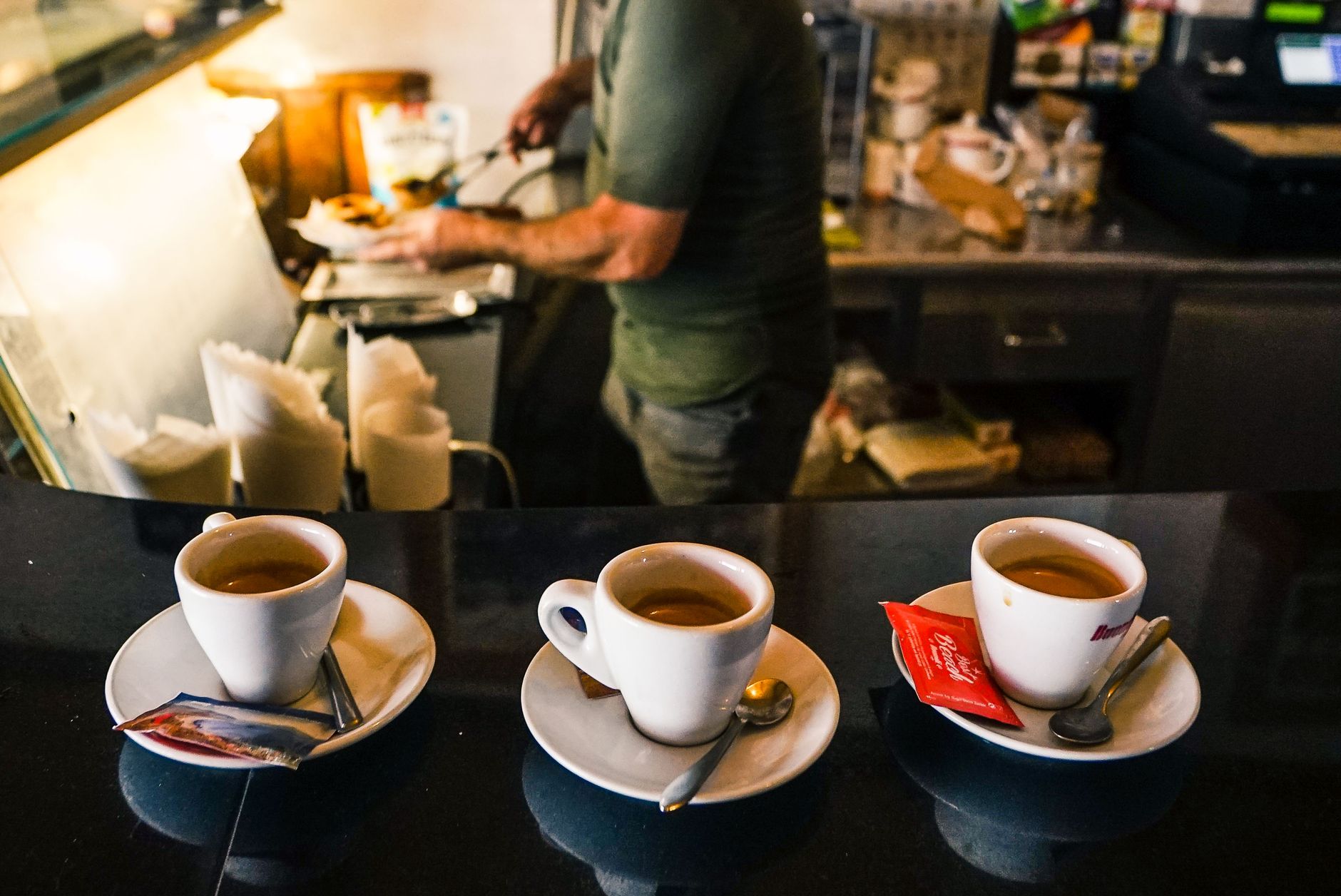 Photo: Wendy Wei via Pexels
Caffeine content varies significantly by brew method, dose, and bean. See How Much Caffeine Is in a Cup of Coffee? (All Brew Methods) for a full breakdown, and Caffeine in Espresso vs Coffee: Which Has More? for the head-to-head.
| Drink | Approx. Caffeine | Residual at 10hr (avg. metabolizer) |
|---|---|---|
| Single espresso (1oz) | 60–75mg | ~12–19mg |
| Double espresso (2oz) | 120–150mg | ~25–37mg |
| 8oz drip coffee | 95–165mg | ~19–41mg |
| 16oz cold brew | 200–350mg | ~39–86mg |
| 12oz brewed tea | 25–50mg | ~5–12mg |
Cold brew is the sleeper hit here — the extended steep concentrates caffeine significantly, and the smooth taste masks how much you’ve consumed. A large cold brew at 3pm can deposit more caffeine at midnight than a double espresso at 10am.
→ See Also
- Coffee Science: The Complete Guide to Extraction, Chemistry & Flavor
- How Much Caffeine Is in a Cup of Coffee? (All Brew Methods)
- Caffeine in Espresso vs Coffee: Which Has More?
FAQ
How long does caffeine stay in your system completely? Complete elimination takes 10–12 hours for average metabolizers, assuming a standard 100–200mg dose. Slow metabolizers or those on inhibiting medications may not fully clear it for 20+ hours. “Out of your system” is technically around 5 half-lives — so 25–30 hours in edge cases.
Does caffeine tolerance affect how fast it leaves your body? Tolerance affects how much you feel caffeine, not how fast it’s metabolized. Regular drinkers have fewer free adenosine receptors, so the same caffeine dose produces less noticeable stimulation — but the pharmacokinetics don’t change. Half-life stays the same; the perceptible effect diminishes.
Can you speed up caffeine metabolism? Not meaningfully. Exercise marginally increases metabolic rate, but the effect on caffeine clearance is minor. Hydration won’t flush caffeine faster — the bottleneck is liver enzyme activity, not renal clearance. The only reliable accelerant is smoking (not recommended for obvious reasons).
Why do I still feel caffeine long after my usual cutoff? Most likely explanations: you consumed more than you think (check the source — cold brew and some specialty drip coffees run high), you’re a slow CYP1A2 metabolizer, or an interacting medication or supplement is slowing clearance. Grapefruit juice inhibits CYP enzymes broadly and can extend caffeine half-life.
Does caffeine half-life change as you age? Yes. Caffeine metabolism slows moderately with age, particularly after 50, as liver enzyme activity declines. Older adults often find they need to cut off caffeine earlier than they did at 30 — not because of changing tolerance but changing pharmacokinetics.
Editorial methodology: Assessments are based on manufacturer specifications, published user reviews, and editorial research. Physical hands-on testing is noted explicitly where it occurred. Rankings reflect our editorial judgment and are not influenced by affiliate commission rates. Full editorial policy · Affiliate disclosure