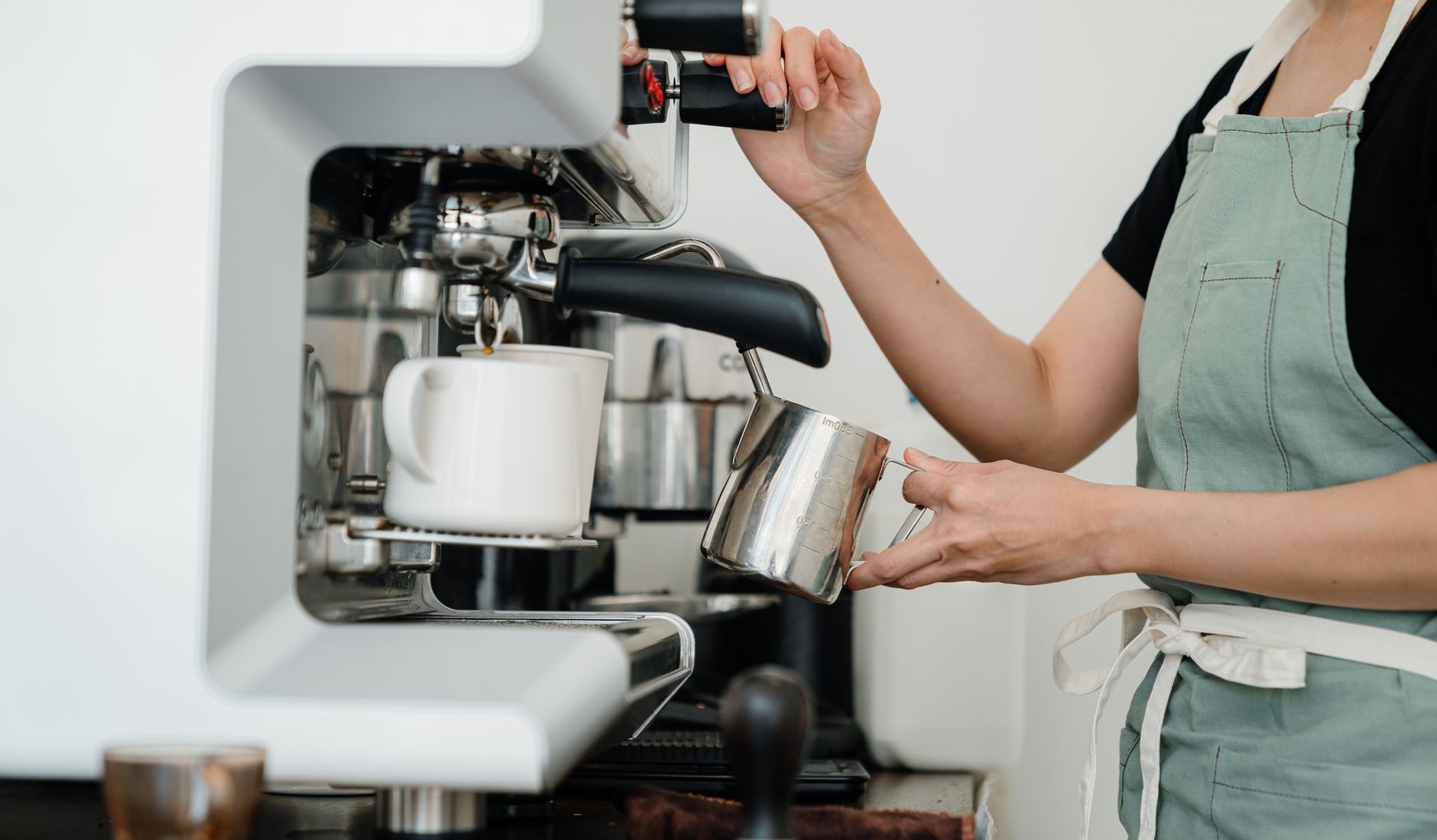
Photo: Pavel Danilyuk via Pexels
Espresso Machine Guide: Every Type, Tier & Top Pick (2026)
TL;DR: Real espresso needs 9 bars of pump pressure — not a Moka pot, not a Nespresso, not a 15-bar marketing spec. For beginners, the Gaggia Classic Pro + Baratza Encore ESP (
$650 total) is the best starting setup. For convenience, the Breville Barista Express ($700) bundles a grinder. For a long-term serious machine, most enthusiasts converge on the Lelit Bianca V3 + Niche Zero (~$2,300). The grinder matters more than the machine.
What Actually Makes a True Espresso Machine?
Direct answer: Espresso requires forcing water at 90–96°C through compacted coffee grounds at exactly 9 bars of pressure. Any machine that can’t reach and hold 9 bars via an internal pump — regardless of price or branding — cannot produce real espresso. Moka pots, AeroPress, and pod machines fail this test.
That 9-bar figure is the whole ballgame. Pressure extracts the coffee oils and soluble compounds that create crema, body, and the concentrated flavour base that lattes and cappuccinos are built on. Drop below 7 bars and you get a strong coffee. At 9 bars, the physics of emulsification kick in and you get espresso.
This immediately eliminates most “espresso-style” machines sold at supermarkets. The clearest tell: a pressurized portafilter. These machines use a two-layer resistance mechanism that partially compensates for coarse or stale grinds — and sets a permanent ceiling on quality. The moment you try to improve with a better grinder or fresher beans, a pressurized portafilter fights you. Real espresso machines use a non-pressurized (commercial-style) portafilter.
The 5 Types of Espresso Machines
Direct answer: The five types are manual (lever), semi-automatic, automatic, super-automatic, and pod machines. Semi-automatic is the standard for serious home espresso — you control extraction start and stop, which gives you full feedback. Super-automatic handles everything with one button. Pod machines optimize for convenience at the cost of flexibility.
1. Manual (Lever) Machines
You pull a spring-loaded lever to generate pressure by hand. No pump, no electronics, no motors. The shot pressure profile is entirely in your hands.
| Spec | Value |
|---|---|
| Control | Maximum |
| Skill required | High |
| Maintenance | Low |
| Noise | Near-silent |
Best for: Enthusiasts who treat espresso as a deliberate ritual — morning isn’t rushed, and tactile feedback from each pull matters.
Not for: Anyone who needs more than 2–3 shots quickly or is still dialing in their grind.
Models: Flair 58, Cafelat Robot, La Pavoni Europiccola.
2. Semi-Automatic Machines
An electric pump generates pressure. You grind, dose, distribute, tamp, lock in the portafilter, start extraction, and stop it yourself. Every variable is yours to control — and every mistake is yours to learn from.
Best for: Anyone who actually wants to understand espresso. The feedback loop between your puck prep, your grind, and the shot result is direct and fast.
Models: Gaggia Classic Pro, Rancilio Silvia, Lelit Bianca, ECM Synchronika. {{AFF:GAGGIA_CLASSIC_PRO}}
3. Automatic Machines
Same as semi-automatic, but the machine stops extraction at a programmed volume. You still grind, dose, and tamp — you just don’t time the shot manually. Good for households that want repeatability without obsessing over timing.
4. Super-Automatic (Bean-to-Cup)
One-touch operation from beans to cup. The machine grinds, doses, tamps, brews, and ejects the puck automatically. Some models also froth milk automatically.
Best for: Households that want genuine espresso quality without learning puck prep.
Trade-off: You give up control over grind consistency, dose, and extraction time — the three variables that define espresso quality. The internal grinders on most super-automatics are serviceable, not excellent.
Models: Jura E6, DeLonghi Magnifica Evo, Breville Oracle Touch, Philips 3200. {{AFF:JURA_E6}}
5. Pod Machines (Nespresso)
Pre-sealed aluminium pods. No grinding, no tamping, no cleanup. Nespresso’s Original line brews at 19 bars through a tiny cake of compressed coffee; the Vertuo line uses centrifugal force. Neither produces textbook espresso, but both produce very good espresso-style drinks quickly.
Best for: Someone who wants a good espresso-adjacent drink in 30 seconds, zero skill required, zero mess.
Not for: Anyone who wants to dial in extraction or use their own beans.
Models: Nespresso Vertuo Next, Nespresso Creatista Pro. {{AFF:NESPRESSO_VERTUO_NEXT}}
Espresso Machine Specs: What Actually Matters
Direct answer: The specs that determine daily quality are boiler type (affects temperature stability and milk steaming), portafilter size and type (54mm vs 58mm; pressurized vs non-pressurized), PID temperature control (±1°C vs ±5°C swings), pump type (vibrational vs rotary), and burr size if there’s a built-in grinder. Marketing specs like “15-bar pump” and “thermoblock” are usually noise.
Boiler Type
| Boiler | Brew & steam simultaneously | Temperature precision | Best for |
|---|---|---|---|
| Single | No (30–60s switch wait) | Good | Espresso-only households, beginners |
| Thermoblock / Thermocoil | Near-simultaneous | Variable | Entry to mid-range |
| Heat Exchanger (HX) | Yes (flush ~30ml first) | Very good | Milk drink households on a budget |
| Dual Boiler | Yes (no flush) | Excellent (separate temps) | Serious home baristas |
The single-boiler wait time sounds minor — it isn’t. If you make two cappuccinos every morning, a 45-second wait between brew and steam adds 90 seconds of dead time. HX machines solve this but require a “cooling flush” before each shot to purge superheated water. Dual boiler is the cleanest solution: brew boiler runs at 93°C, steam boiler at 120°C, fully independent.
Portafilter: 54mm vs 58mm
Most entry machines (DeLonghi, entry Breville) use a 54mm portafilter. Nearly all prosumer and commercial machines use 58mm. The difference: a 58mm basket holds 18–21g of ground coffee, which is the standard dose for high-extraction espresso. A 54mm maxes out at ~16–18g depending on basket depth.
More importantly, the aftermarket basket ecosystem — VST, Pullman, Wafo — is built around 58mm. If long-term upgradeability matters, 58mm is the right call.
PID Temperature Control
A PID (Proportional-Integral-Derivative) controller keeps boiler temperature within ±0.5–1°C of your target. Without one, boiler temperature can swing ±5°C or more, which directly affects extraction — lighter roasts in particular require precise temperature (93–96°C) to avoid sourness.
Standard on virtually all machines priced $500+. Critical if you pull light roasts.
Pump Type
| Pump | Noise | Pressure consistency | Lifespan | Cost |
|---|---|---|---|---|
| Vibrational (ULKA) | Loud (buzzing) | Good | 5–8 years | Low |
| Rotary | Quiet | Excellent | 15–20 years | High |
Entry and mid-range machines use vibrational ULKA pumps. Prosumer machines ($1,500+) often move to rotary pumps. The pressure difference is real but subtle at the cup level. The noise difference is not subtle — a vibrational pump in a small kitchen is loud enough to wake household members.
Built-in Grinder (Super-Automatics and Combo Machines)
| Spec | What to look for |
|---|---|
| Burr type | Conical burr preferred; avoid blade grinders |
| Burr size | ≥38mm for decent particle distribution |
| Grind settings | 8+ discrete steps; stepless is better |
| Retention | Under 0.5g; high retention causes stale grinds mixing with fresh |
Built-in grinders on machines like the Breville Barista Express (conical, 54mm burrs) are competitive up to ~$800. Above that, a standalone grinder consistently outperforms any combo machine grinder.
Price Tiers: What You Get at Each Level
Direct answer: Under $300 means pressurized portafilter and a ceiling you can’t break through with better technique or beans. The real entry point for proper espresso is $400–$700: non-pressurized portafilter, 9-bar pump, actual feedback. Above $700 you get better temperature control, milk steaming capability, and longer machine life. Above $1,500 you get dual boilers and flow control.
Under $300 — Entry Level
Machines in this range (DeLonghi EC155, Bialetti Moka Express, Mr. Coffee) use pressurized portafilters. Some are marketed as “15-bar” — that’s the pump’s maximum output, not the brew pressure. The OPV (over-pressure valve) typically caps brewing at 9 bars, but the pressurized basket is the real limiter.
What you can’t do with a pressurized machine: Taste the difference between a $15 bag of commodity coffee and a $25 bag of single-origin Kenyan. The pressurized portafilter flattens everything. It’s genuinely fine for learning to pull a shot — as long as you know you’ll outgrow it within a year.
$400–$700 — The Real Starting Point
The Gaggia Classic Pro ($450) removed the pressurized basket that plagued its predecessor, giving you a genuine 58mm commercial portafilter. It has a single boiler, no PID (though one can be added for ~$30 DIY), and a small steam wand that requires technique but works. It’s the most recommended beginner machine in serious espresso communities.
The Rancilio Silvia ($750) is a step up: better build quality, a commercial-grade group head, and a wider boiler. Same single-boiler limitations as the Gaggia.
The Breville Barista Express ($700) bundles a conical burr grinder — a real advantage if you’re buying your first setup and don’t want to research grinders separately. The grinder is competitive up to about $300 standalone. {{AFF:BREVILLE_BARISTA_EXPRESS}}
$700–$1,500 — Prosumer Entry
Heat exchanger machines and dual-boiler entry models live here. Key representative: Breville Dual Boiler ($1,500) — two separate boilers, PID, 58mm non-pressurized, programmable pre-infusion. The Breville Dual Boiler punches significantly above its price against European competitors at the same spec level.
Also worth considering: Lelit Anna (HX, ~$700), Rocket Appartamento (HX, ~$1,200), Profitec Pro 300 (dual boiler, ~$1,300).
$1,500–$3,000 — Where Most Enthusiasts Land
The Lelit Bianca V3 (~$1,800) is the machine that most serious home espresso communities treat as the reference point. Dual boiler, flow control paddle (lets you manually adjust extraction pressure in real time), commercial-grade E61 group head, rotary pump. Designed to last 15–20+ years with proper maintenance. {{AFF:LELIT_BIANCA}}
The flow control paddle is the differentiating feature: it lets you pre-infuse slowly, ramp up pressure, and pull longer lower-pressure shots — the technique behind most specialty cafe “slow shots.” At $1,800, it’s a serious outlay that makes sense only if espresso is a genuine hobby.
Also worth considering: ECM Synchronika, Profitec Pro 500, Rocket R58.
$3,000+ — La Marzocco Territory
The La Marzocco Linea Mini ($5,500) is a scaled-down commercial Linea — dual boiler, saturated group head, commercial-grade everything. The marginal espresso quality improvement over a Lelit Bianca is real but incremental. You’re paying for the engineering heritage, the build quality, and the statement.
Diminishing returns are steep past $3,000 for home use. The Lelit Bianca at $1,800 gets you 90% of the way there.
The Grinder: More Important Than the Machine
Direct answer: A $500 grinder paired with a $400 machine produces better espresso than a $400 machine paired with a $100 grinder. Grind consistency determines particle size distribution, which determines extraction evenness. A blade grinder or cheap burr grinder creates uneven particles — fine powder over-extracts, coarse chunks under-extract, and the two cancel each other out into a mediocre shot regardless of machine quality.
Why Espresso Grinders Are Different
Espresso requires a very fine, precise grind. The margin for error is measured in microns — a grind setting that produces a 27-second shot on Monday might pull at 21 seconds on Friday as humidity changes. A good espresso grinder must:
- Hold extremely tight particle size distribution at fine settings
- Allow micro-adjustments (stepless or near-stepless)
- Have low grind retention so yesterday’s dose doesn’t contaminate today’s
Grinder Recommendations by Machine Budget
| Machine budget | Minimum grinder | Recommended |
|---|---|---|
| Under $500 | Baratza Encore ESP ($195) | Eureka Mignon Silenzio ($330) |
| $500–$1,000 | Eureka Mignon Silenzio ($330) | Niche Zero ($540) |
| $1,000–$2,000 | Niche Zero ($540) | Eureka Mignon Specialita ($450) |
| $2,000+ | Niche Zero / DF64 | Weber Key / Lagom P64 |
The Niche Zero is the dominant single-dose grinder recommendation at the $400–$600 price point. Near-zero retention (0.1g or less), conical steel burrs, and a dial that makes dialing in simple. It’s the closest thing to consensus in the home espresso world. {{AFF:NICHE_ZERO}}
The Baratza Encore ESP ($195) is the minimum-viable grinder for a Gaggia Classic Pro setup. It gets you to good espresso; you will notice its limits within 6–12 months and want to upgrade. Buy the Niche first if your budget allows.
Best Espresso Machines for Every Buyer (2026)
Direct answer: Match the machine to your actual use case. For beginners learning puck prep: Gaggia Classic Pro. For households wanting convenience: Breville Barista Express or Jura E6. For milk-drink households: any HX or dual-boiler machine. For pure espresso craft with a long-term horizon: Lelit Bianca V3. For zero-effort quality: Nespresso Creatista Pro.
Full Comparison Table
| Machine | Price | Boiler | Portafilter | PID | Pump | Best For |
|---|---|---|---|---|---|---|
| Gaggia Classic Pro | ~$450 | Single | 58mm, non-pressurized | No (DIY-addable) | Vibrational | Beginners who want real espresso |
| Rancilio Silvia | ~$750 | Single | 58mm, non-pressurized | No | Vibrational | Beginners wanting better build quality |
| Breville Barista Express | ~$700 | Thermocoil | 54mm, non-pressurized | Yes | Vibrational | All-in-one, no separate grinder needed |
| Breville Dual Boiler | ~$1,500 | Dual | 58mm, non-pressurized | Yes | Vibrational | Dual boiler at US-market value pricing |
| Lelit Bianca V3 | ~$1,800 | Dual | 58mm, non-pressurized | Yes | Rotary | Long-term investment, flow control |
| Jura E6 | ~$1,100 | Thermoblock | N/A (bean-to-cup) | Yes | Vibrational | Convenience-first households |
| Nespresso Creatista Pro | ~$450 | Thermoblock | N/A (pod) | No | Vibrational | Speed + milk drinks with zero skill |
Verdict by Buyer Archetype
Best for: Learning espresso properly
Gaggia Classic Pro + Baratza Encore ESP (~$650 total). Forces you to understand puck prep and grind. Everything you learn transfers to better machines.
Best for: All-in-one convenience without super-auto simplification
Breville Barista Express (~$700). You still pull your own shots, but the grinder is built-in. Good stepping stone before separating the two.
Best for: Serious milk drinks (daily cappuccinos, flat whites)
Lelit Anna or Rocket Appartamento at $700–$1,200. HX machines let you steam immediately after pulling a shot — the single biggest workflow advantage for milk-drink households.
Best for: Long-term serious home espresso
Lelit Bianca V3 + Niche Zero (~$2,300). Most enthusiasts who buy this setup stop looking for upgrades. Flow control, dual boiler, rotary pump, 15+ year lifespan.
Best for: Zero learning curve, one-touch quality
Jura E6 (~$1,100). Best-in-class bean-to-cup. The grinder and brewing unit are serviceable by Jura.
Milk Steaming: What Each Machine Can Actually Do
Direct answer: Steaming milk for lattes and cappuccinos requires generating dry steam at pressure, then stretching and spinning the milk in a jug to create microfoam. Single-boiler machines require a 30–60 second wait between pulling a shot and steaming. HX and dual-boiler machines can steam immediately. Pod machines and super-automatics automate this entirely, at the cost of microfoam quality.
Steam Performance by Machine Type
| Machine type | Steam pressure | Simultaneous brew + steam | Microfoam quality | Wait time |
|---|---|---|---|---|
| Single boiler | Low–medium | No | Good with technique | 30–60s |
| Thermoblock / Thermocoil | Medium | Near-simultaneous | Decent | ~5–10s |
| Heat exchanger | High | Yes (flush first) | Very good | Flush only (~5s) |
| Dual boiler | High | Yes | Excellent | None |
| Super-automatic | Medium (auto) | Yes | Consistent, not artisan | None |
For a household pulling one shot per morning: a single-boiler machine’s wait time is barely noticeable. For a household making two or more cappuccinos: the workflow difference between a single boiler and a dual boiler is significant enough to justify the price gap.
Maintenance: The Part Most Buyers Miss
Direct answer: All espresso machines require regular cleaning to function correctly. Budget 5 minutes per day for basic wipe-down and purge, 15 minutes weekly for backflushing or group head cleaning, and 30 minutes monthly for descaling if you use tap water. Skip maintenance for 3–6 months and extraction suffers before the machine shows any visible problems.
Maintenance Schedule
| Frequency | Task |
|---|---|
| Every shot | Purge steam wand after use; wipe group head gasket; knock and rinse portafilter |
| Weekly | Backflush with water only (machines with 3-way solenoid); deep-clean portafilter basket with Cafiza; wipe machine exterior |
| Monthly | Descale if using non-filtered tap water; inspect group head gasket; Cafiza backflush (with detergent) |
| Annually | Replace group head gasket and shower screen; check pump pressure; inspect OPV setting |
Water matters more than most buyers expect. Hard water (above 150 ppm TDS) scales boilers in months. A single scaling event inside a boiler is invisible from outside but degrades temperature stability and flow restriction immediately. Use filtered water — a BWT Penguin or similar pitcher-style filter (target 75–150 ppm TDS) costs $40 and pays for itself within the first year in avoided descaling. {{AFF:BWT_PENGUIN}}
Repairability by Brand
| Brand | Parts availability | DIY difficulty | Cost of repair |
|---|---|---|---|
| Gaggia | Excellent (global parts network) | Low — designed to be serviced | $15–$50 typical repair |
| Rancilio | Very good | Low | $20–$60 |
| Breville / Sage | Good (within warranty period) | Medium | Often replace-vs-repair |
| Lelit | Good (European parts) | Medium | $30–$80 |
| La Marzocco | Expensive but rarely needed | Medium–High | $100–$250, but machines rarely fail |
| Jura | Proprietary service centers | Not DIY | $150–$400 service interval |
Common Mistakes to Avoid
Direct answer: The most common and costly mistakes are buying a pressurized-portafilter machine (caps quality permanently), buying a machine without a matching grinder budget, using tap water (scales the boiler), and grinding too coarsely (the most common cause of sour, weak shots).
Mistake 1: Blaming the machine when the grinder is the problem.
A shot that runs too fast (under 20 seconds) and tastes sour is almost always a grind problem — too coarse, or too little dose. Recalibrate the grinder before diagnosing the machine.
Mistake 2: Buying a machine 3 tiers above your grinder budget.
A $1,200 machine with a $80 grinder will produce worse espresso than a $450 machine with a $300 grinder. Allocate at least 40% of your total budget to the grinder.
Mistake 3: Using distilled or heavily softened water.
Zero-mineral water is as damaging as hard water. It aggressively leaches metal from boilers and group heads. Target 75–150 ppm TDS.
Mistake 4: Tamping too hard or unevenly.
~30 lbs of consistent pressure is all that’s needed. Uneven tamp creates channels — water finds the path of least resistance through the puck and most of the coffee goes under-extracted. Consistent level tamp matters more than force.
Mistake 5: Skipping pre-infusion.
Many machines, including the Gaggia Classic Pro, support a manual pre-infusion by opening the steam knob slightly before starting the pump. Pre-infusing for 5–8 seconds gently wets the puck and dramatically reduces channeling.
→ See also: Best Espresso Machine Under $500 (2026) · Semi-Automatic vs Super-Automatic Espresso Machines: Which Should You Buy? · How to Descale an Espresso Machine
FAQ
What’s the difference between a 15-bar and a 9-bar espresso machine?
Marketing. Espresso brews at 9 bars of pressure — that’s the physics of the extraction. “15-bar pump” refers to the pump’s maximum pressure output, not what’s actually used during brewing. All quality machines set their OPV (over-pressure valve) to 9 bars. A 15-bar pump rating tells you nothing useful about espresso quality.
Do I need a separate grinder, or can I use pre-ground coffee?
A burr grinder is effectively mandatory for consistent quality. Pre-ground coffee degrades within days of the bag being opened, and the particle size can’t be adjusted to match your machine. The grinder is the single highest-impact upgrade in any espresso setup — more than the machine itself.
How long does it take to learn to pull a good shot?
First decent shot: 1–2 days. Consistently good shots: 2–4 weeks. The learning curve is steep at the start (grind calibration, tamping consistency, learning to read a shot) then plateaus quickly. Most common early mistake: grind too coarse, which produces sour, weak shots.
What’s the difference between a heat exchanger and a dual-boiler machine?
Both allow you to brew and steam simultaneously. An HX machine uses a single boiler with a copper coil inside — water for brewing passes through the coil and picks up heat. This requires a “cooling flush” before each shot to purge superheated water from the coil. A dual-boiler machine has completely separate brew and steam boilers at independently controlled temperatures — no flush needed, better temperature stability.
How important is water quality for espresso?
Very. Hard water (above 150 ppm TDS) scales boilers and group heads, degrading extraction and shortening machine life. Soft or distilled water damages metal components. The target is 75–150 ppm TDS, which a BWT or Brita Maxtra filter achieves from most tap water sources.
What’s the best espresso machine for a first-time buyer in 2026?
The Gaggia Classic Pro ($450) paired with a Baratza Encore ESP grinder ($195). This setup gets you real, non-pressurized espresso, teaches you every variable that matters, and produces results that are hard to improve on below $2,000 total spend. If you want to skip the grinder learning curve, the Breville Barista Express (~$700) is the best all-in-one option.
Can any espresso machine make cappuccinos and lattes?
Any machine with a steam wand can stretch milk. The quality and speed varies significantly by boiler type. Single-boiler machines require a 30–60 second wait between pulling a shot and steaming. HX and dual-boiler machines can do both simultaneously. Super-automatics handle steaming automatically. The wand technique (stretching vs. spinning) affects microfoam quality regardless of machine.